What happens to the sulfur supply as the world moves away from fossil fuels?
Sulfuric acid is essential for producing fertilizer and extracting the metals used in batteries and electronics. But over 90% of the world's sulfur comes from refining fossil fuels — the very industry that decarbonisation is designed to shrink.
Around 246 million tonnes of sulfuric acid are used every year. It is the most widely produced chemical on Earth by mass. Most people have never heard of it, but it is embedded in two things that matter enormously: food production and the green energy transition.
"Sulfur in the form of sulfuric acid is a crucial part of our modern industrial society. It is required for the production of phosphorus fertiliser and manufacturing lightweight electric motors and high-performance lithium-ion batteries." — Maslin et al. (2022)
About two-thirds of sulfuric acid goes into producing phosphorus fertiliser. Without it, you cannot extract phosphate from rock at the scale needed to feed eight billion people. Phosphate, alongside nitrogen, is one of the two essential nutrients for crop growth. It's estimated that nitrogen fertiliser alone supports approximately half of the global population. There is no viable substitute for sulfuric acid in phosphate processing at the volumes required.
The rest goes largely into extracting metals from ores — copper, cobalt, and nickel — which are essential for lithium-ion batteries, electric motors, and electronic infrastructure. As the world electrifies, demand for these metals is growing fast.
Where does all this sulfur come from? According to the U.S. Geological Survey, over 85 million metric tons of sulfur were recovered globally in 2023, with around 92% of that volume sourced from petroleum refineries and natural gas processing plants. Crude oil naturally contains 1–3% sulfur by weight, and regulations require refiners to remove it to prevent sulfur dioxide emissions — the gas that causes acid rain. The sulfur that comes out of this process is cheap, abundant, and available wherever oil is refined.
"Because of government regulations on allowable sulfur emissions from processing facilities, discontinuing sulfur recovery operations while continuing to process oil and gas is never an option." — Wagenfeld et al. (2019)
This arrangement has worked well for decades. But it creates a dependency that is easy to overlook.
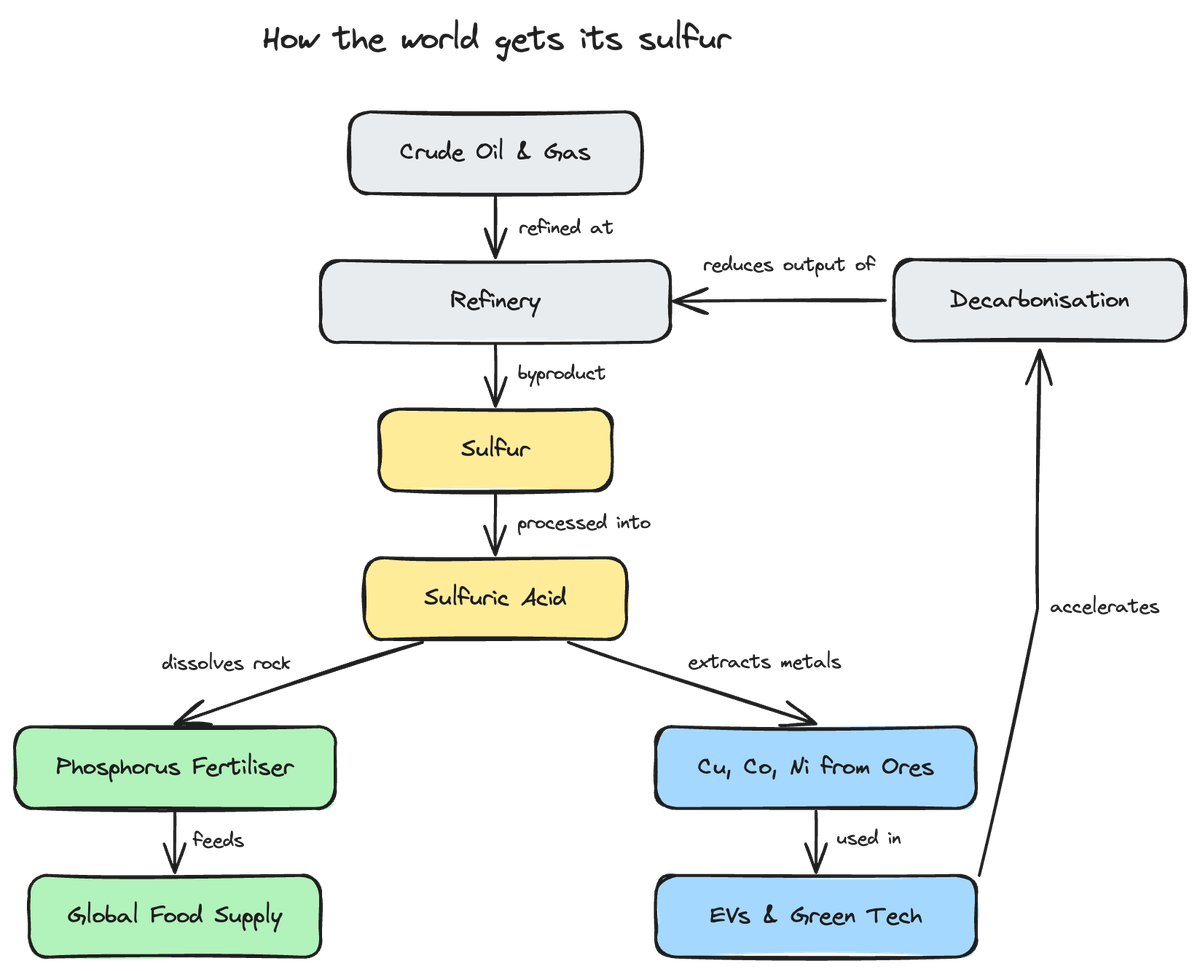
The diagram below shows the full chain: from crude oil through refining, to sulfur, to sulfuric acid, and from there to the two industries that depend on it — fertiliser and green technology. On the right, the loop that creates the tension: EVs and green tech accelerate decarbonisation, which reduces the refining that produces the sulfur they need.
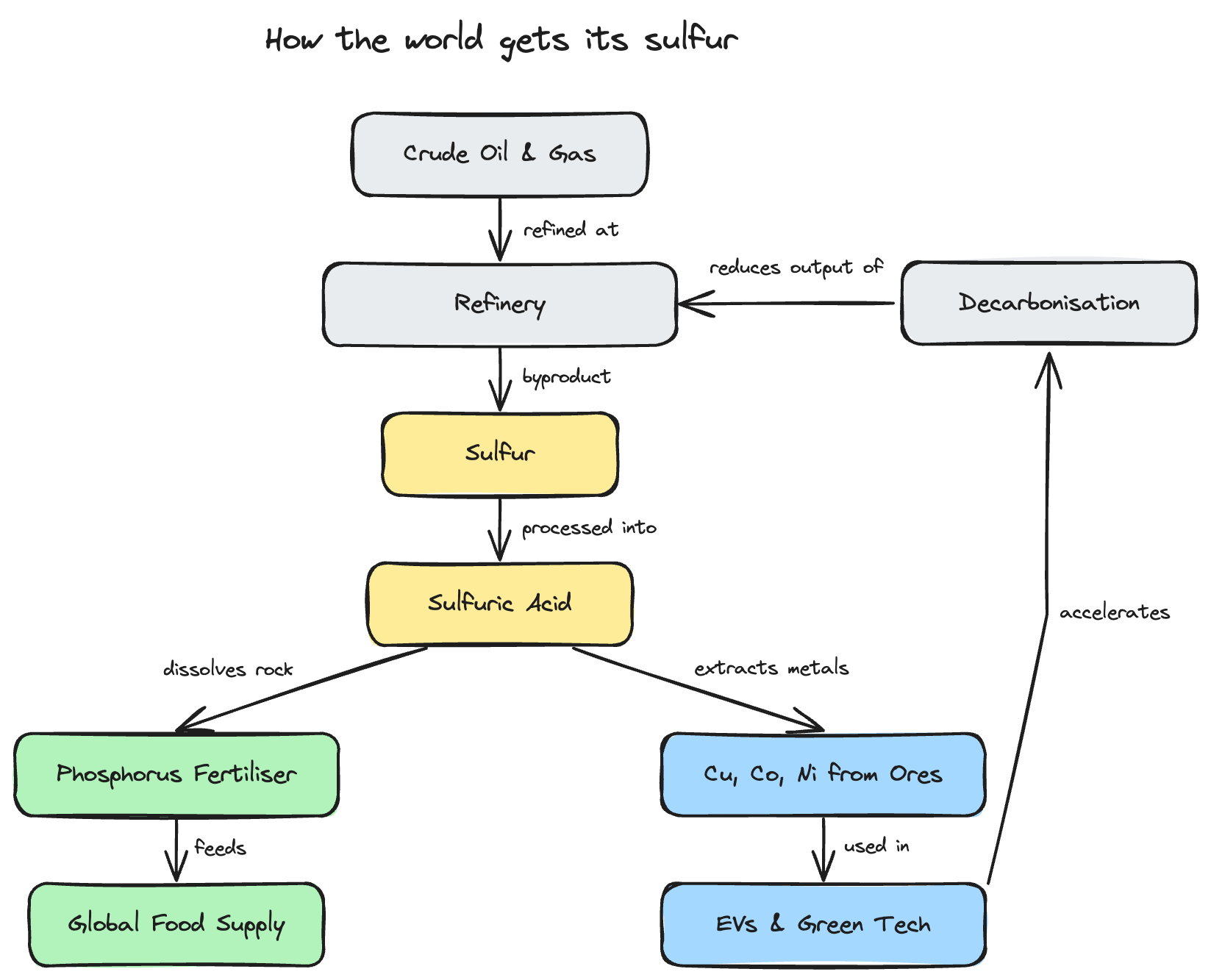
Decarbonisation reduces fossil fuel refining — and with it, the supply of sulfur
As the world shifts away from fossil fuels, oil refining will decline. This is the intended effect of decarbonisation policies. But it has an unintended side effect: it also reduces the supply of sulfur.
This matters because the industries that need sulfur most — fertiliser production and green technology manufacturing — are also the industries that decarbonisation is meant to support or protect. The batteries and electric vehicles that help reduce fossil fuel use require metals that are extracted using sulfuric acid, which is itself a byproduct of the fossil fuel industry.
Researchers at University College London were the first to quantify this problem. In a 2022 study published in The Geographical Journal, Mark Maslin and colleagues estimated that by 2040, the annual shortfall in sulfuric acid could be between 100 and 320 million tonnes — a gap of 40% to 130% of current production, depending on how quickly decarbonisation occurs.
"As the world decarbonises over the next three decades, the supplies of sulfur will drop, just when the material is needed most." — Maslin et al. (2022)
To put that in perspective: even the lower end of that range would mean losing nearly half of today's global supply.
Demand is rising at the same time supply is expected to fall
The problem is not just that supply will decline. Demand is also increasing.
Global demand for sulfuric acid is projected to rise from 246 million to over 400 million tonnes per year by 2040, driven by two forces: more intensive agriculture to feed a growing population, and rapidly expanding production of batteries and electric vehicles.
The growth in new energy demand is already visible. In China, sulfur consumption by the new energy sector reached 8% of total demand in 2025 — a three percentage point increase from the prior year — driven largely by the production of lithium iron phosphate batteries.
"Sulfur is a byproduct of oil refining and natural gas processing. According to IEA forecasts, under the context of energy transition, global refining capacity and processing volume will peak after 2035 and gradually decline, fundamentally limiting the long-term supply ceiling of sulfur." — SunSirs (2025)
If solid-state battery technology is commercialised, the demand for high-purity sulfur could be several times that of traditional lithium-ion batteries. This means the gap between supply and demand will widen from both directions at once.
When supply tightens, industries that can pay more will outbid those that cannot
If sulfur becomes scarce and expensive, not all industries will be affected equally.
The metals and battery industries can absorb higher sulfur prices more easily: the value of a tonne of lithium or cobalt is far greater than the value of a tonne of fertiliser. This means that as prices rise, green technology manufacturers are likely to outbid fertiliser producers for the limited supply.
"Prices of sulfuric acid will rise, which could increase the cost of food, especially if sulfuric acid-using green tech industries outbid fertiliser producers. As ever, developing countries will be hit hardest." — Maslin et al. (2022)
The downstream consequence is higher fertiliser costs, which feed through to higher food prices. Developing countries, where food makes up a larger share of household spending, would be hit hardest.
This is not a prediction — it depends on how quickly decarbonisation proceeds and whether alternative sulfur sources are developed in time. But it illustrates an important tension: the same transition that is designed to address climate change could, if not managed carefully, put pressure on food systems.
There are ways to close the gap, but none are straightforward
There are broadly three ways to respond to a sulfur shortfall. Each involves tradeoffs — and each acts on a different part of the system. The diagram below shows where each intervention targets.
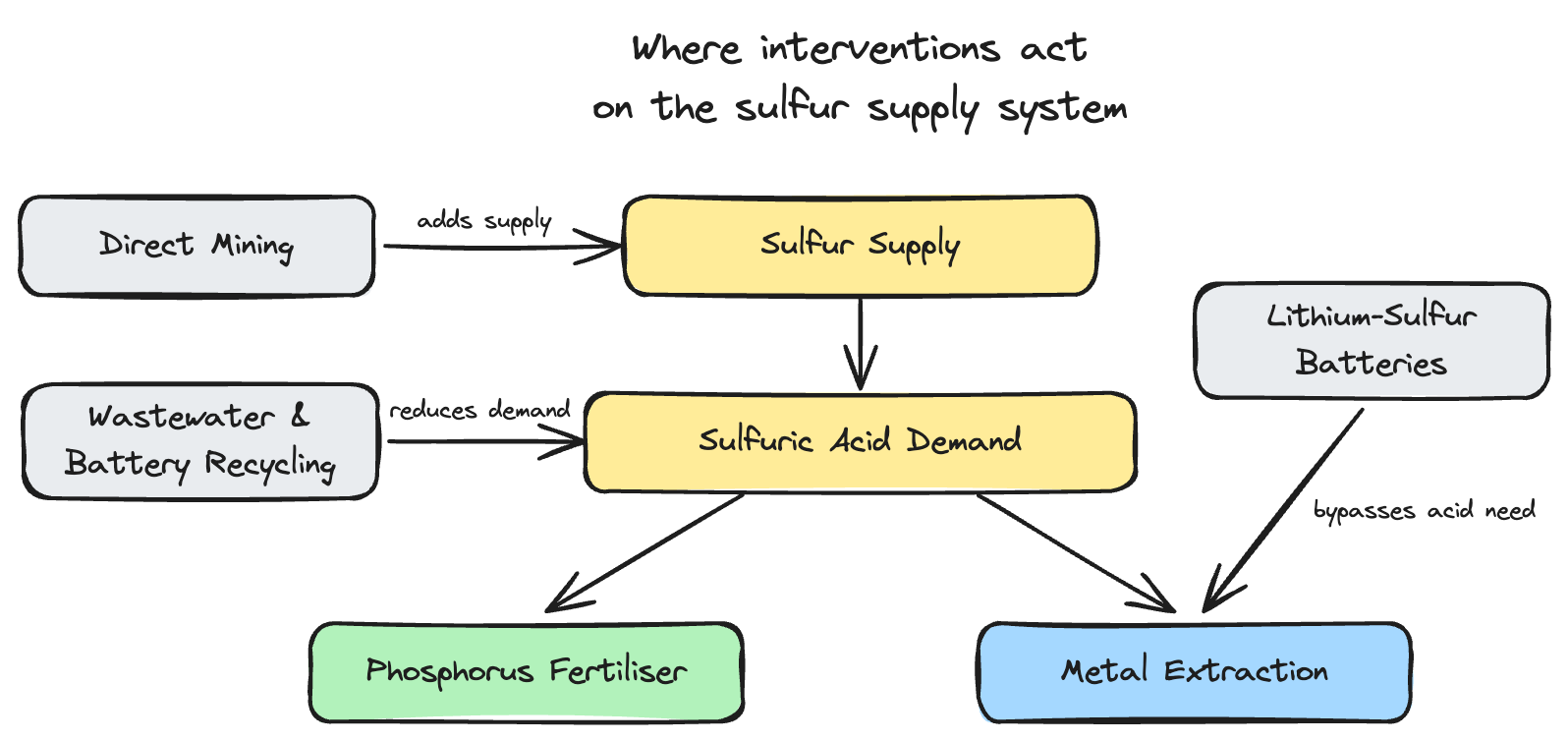
The first is to mine sulfur directly. Sulfur is the fifth most abundant element on Earth, and large deposits of sulfate minerals like gypsum exist. The USGS estimates that resources of elemental sulfur in evaporite and volcanic deposits, combined with sulfur associated with natural gas, petroleum, tar sands, and metal sulfides, total about 5 billion tons — and the sulfur in gypsum and anhydrite is "almost limitless." But extracting elemental sulfur from these sources is expensive, energy-intensive, and environmentally destructive — a stark contrast to the near-zero marginal cost of recovering it as a refining byproduct.
"What we're predicting is that as supplies of this cheap, plentiful, and easily accessible form of sulfur dry up, demand may be met by a massive increase in direct mining of elemental sulfur. This, by contrast, will be dirty, toxic, destructive, and expensive." — Mark Maslin, UCL (2022)
The second is to reduce demand through recycling. Phosphorus can be recovered from wastewater and sewage, reducing the need for freshly mined phosphate rock and the sulfuric acid used to process it. Lithium battery recycling can recover cobalt, nickel, and other metals without requiring new ore extraction. The UCL researchers suggest both recycling phosphorus in wastewater and increasing the recycling of lithium batteries as ways to reduce sulfur dependency. Both approaches are promising but are not yet operating at the scale needed to significantly offset the projected shortfall.
The third is to develop technologies that reduce or bypass the need for sulfuric acid altogether. Lithium-sulfur batteries, for example, use sulfur directly as a cathode material rather than as an intermediate processing chemical. As one researcher put it: every country that can extract or refine oil will produce sulfur, making local battery production possible. If commercialised at scale, lithium-sulfur batteries could turn sulfur from a bottleneck into a battery component. But this technology is still in development and faces significant engineering challenges.
The sulfur supply problem is easy to miss — and that is part of the problem
Sulfur has been cheap and plentiful for so long that its supply is rarely questioned. As the UCL researchers point out, this is precisely why the issue has received so little attention.
"What makes the sulfur issue so difficult to deal with is that there is currently an extremely cheap plentiful supply of sulfur, which means no government or company is going to invest in developing alternative supplies or recycling." — Maslin et al. (2022)
The broader point is that decarbonisation does not just change the energy system. It reorganises the material supply chains that the modern economy depends on. Sulfur is one example — there will be others. The sooner these dependencies are identified, the more time there is to develop alternatives before shortages become acute.
"By recognising the sulfur crisis now, national and international policies can be developed to manage future demand, increase resource recycling, and develop alternative cheap supplies which have minimal environmental and social impact." — Maslin et al. (2022)
Sources:
- Maslin, M., Van Heerde, L., & Day, S. (2022). Sulfur: A potential resource crisis that could stifle green technology and threaten food security as the world decarbonises. The Geographical Journal.
- U.S. Geological Survey. (2025). Mineral Commodity Summaries: Sulfur.
- SunSirs. (2025). Sulfur Market: 2025 Review and 2026 Outlook.
- U.S. Environmental Protection Agency. (2023). Sulfur Supply Chain Profile.
- Wagenfeld, J-G. et al. (2019). Sustainable applications utilizing sulfur, a by-product from oil and gas industry. Waste Management.
- UCL News. (2022). Sulfur shortage: a potential resource crisis looming as the world decarbonises.